

Wood Deck Maintenance in Louisiana: The 2026 Preservation Guide
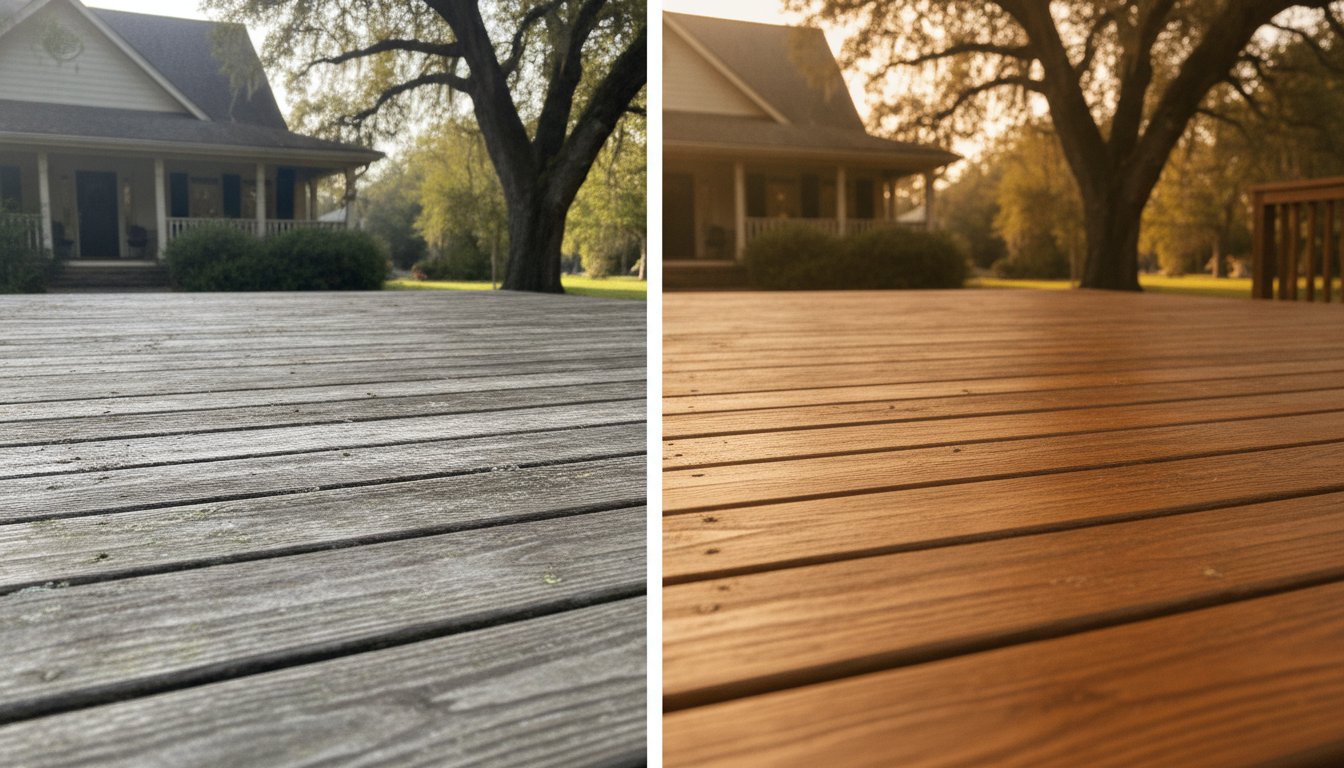
In Louisiana, a wood deck isn’t just an outdoor space; it’s a living structure locked in a constant battle against the most aggressive climate in the country. You’ve likely seen the transformation happen far too quickly. A beautiful porch turns grey, grows slick with green mold, or begins to warp under the relentless UV heat of a Lafayette summer. It’s frustrating to invest in your property only to watch the humidity and the threat of Formosan termites slowly degrade the wood. We know you want a deck that remains a safe, splinter-free sanctuary for your family, not a slippery liability that hurts your home value.
This 2026 preservation guide provides the professional techniques and seasonal schedules required to protect your wood from rapid biological decay. By following these expert steps, you’ll ensure your outdoor living area maintains its beauty and structural integrity for 20 years or more. We’ll explore the specific oil-based sealants and cleaning rhythms that help you avoid the premature need to hire a deck replacement contractor in Louisiana, a service many residents rely on when maintenance is neglected. From deep-cleaning mold to blocking intense heat, you’re about to learn how to keep your deck looking brand new for decades.
Key Takeaways
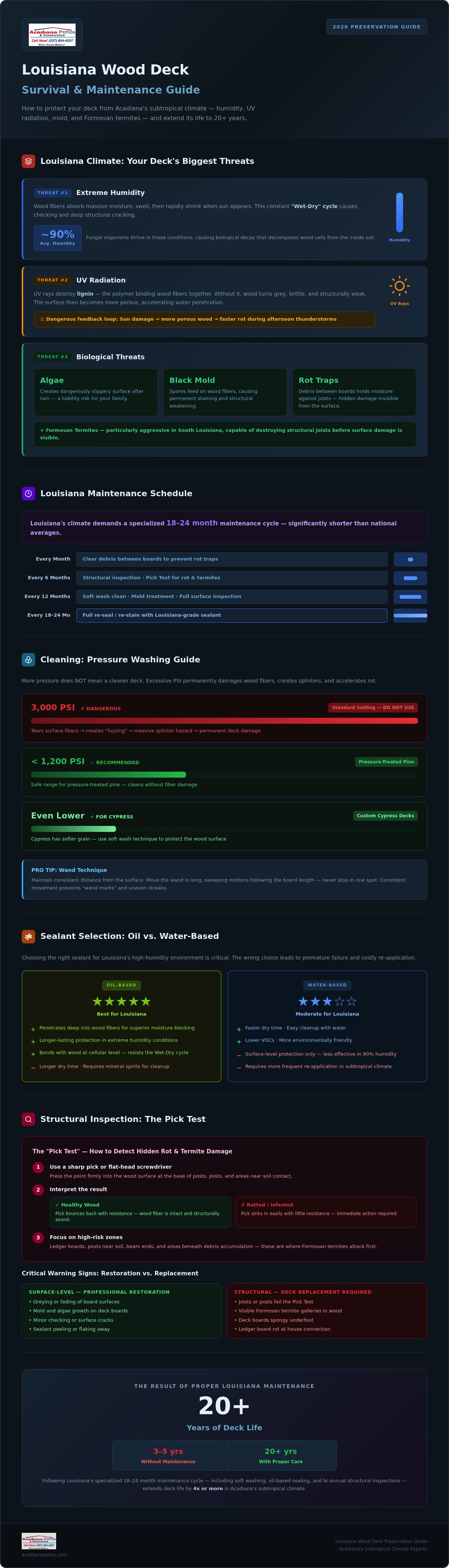
- Understand why Louisiana’s extreme humidity and UV radiation require a specialized 18-24 month maintenance cycle to prevent structural decay.
- Learn the “soft wash” technique and why high-pressure cleaning can permanently damage wood fibers and accelerate rot in our tropical climate.
- Discover the specific performance differences between oil-based and water-based stains to choose the best moisture protection for the Lafayette environment.
- Identify the critical structural warning signs that mean it’s time to call a deck replacement contractor Louisiana families trust for safety and long-term durability.
- Master simple inspection methods like the “Pick Test” to catch Formosan termite activity and hidden rot before they become costly, dangerous failures.
The Louisiana Climate vs. Your Wood Deck: A Survival Guide
Louisiana isn’t just humid; it’s a subtropical environment that treats untreated wood like fuel for decay. While other states deal with snow or dry heat, Acadiana homeowners face a relentless cycle of moisture and radiation. This climate accelerates the breakdown of even the toughest materials, making it essential to understand the science of wood preservation techniques before your structure requires a professional intervention. Since 1985, we’ve seen how the local environment can turn a solid structure into a safety hazard in just a few seasons if the owner doesn’t intervene.
Why Humidity is the #1 Enemy of Acadiana Decks
Wood is a naturally porous material that breathes and reacts to its surroundings. In Lafayette, where humidity often hovers near 90%, wood fibers absorb massive amounts of internal moisture, causing the boards to swell significantly. When the sun finally breaks through the clouds, the wood dries rapidly and shrinks. This constant expansion and contraction, known as the ‘Wet-Dry’ cycle, leads to checking and deep structural cracking that compromises the wood’s integrity. Biological decay in Louisiana is the rapid decomposition of wood cells caused by fungal organisms that thrive in our consistent 90% humidity and warm temperatures. If these cycles aren’t managed through proper sealing, the boards will eventually fail, forcing you to search for a deck replacement contractor Louisiana residents trust for major structural rebuilds.
UV Damage: More Than Just Fading
The Acadiana sun does more than just bleach the color out of your boards. UV radiation specifically targets lignin, which is the natural organic polymer that holds wood fibers together. As lignin breaks down, the wood becomes gray, brittle, and structurally weak. Once this protective bond is gone, the surface becomes even more porous, allowing water to penetrate deeper into the core during our frequent afternoon thunderstorms. This creates a dangerous feedback loop where sun damage makes the wood even more susceptible to rot.
Shaded decks in Lafayette face a different set of challenges than sun-drenched ones. While they might avoid some UV breakdown, the lack of sunlight prevents moisture from evaporating. This creates a damp, cool microclimate where biological threats flourish. You’ll often see these specific issues on South Louisiana decks:
- Green Algae: This creates a dangerously slippery surface after any amount of rain.
- Black Mold: These spores feed on the wood fibers and can cause permanent staining.
- Drainage Rot: Debris trapped between boards holds moisture against the joists, leading to “rot traps” that aren’t visible from the surface.
When maintenance is ignored, these factors combine to create a structure that is no longer safe for your family. A seasoned deck replacement contractor Louisiana expert can identify when the damage has moved from the surface into the structural frame, ensuring your home remains both beautiful and secure.
Step-by-Step Cleaning and Surface Preparation
Proper preparation is the most overlooked phase of maintenance, yet it determines how long your sealant will actually last. In South Louisiana, this process begins with a physical inspection of the gaps between your boards. Falling leaves, pine needles, and dirt collect in these spaces, creating “rot traps” that hold moisture against the structural joists for weeks. Clearing this debris is essential for airflow. Without it, even the best properly finishing wood decks strategy will fail as the wood rots from the inside out. It’s a simple step with massive consequences.
The Dangers of High-Pressure Washing
Many homeowners assume that higher pressure equals a cleaner deck. This is a dangerous misconception. Using a standard 3000 PSI setting can “fuzz” the wood by tearing the surface fibers; this creates permanent damage and massive splinter hazards. For pressure-treated pine, we recommend staying below 1200 PSI. If you are working with custom cypress decks and porches, the pressure should be even lower to protect the softer grain. To avoid “wand marks” or uneven streaks, maintain a consistent distance from the surface and move the wand in long, sweeping motions that follow the length of the board. Consistent movement is key.
Selecting a Louisiana-Grade Deck Cleaner
Generic store-bought cleaners often lack the strength to handle the deep-rooted algae and fungal spores native to Acadiana. While chlorine bleach is common, it can be hard on your landscaping and can dry out the wood’s natural oils. Oxygen bleach is a safer, more effective alternative for lifting organic stains without damaging the wood’s cellular structure. You should look for cleaners with specific antimicrobial additives designed to kill spores rather than just washing them away.
After the chemical cleaning, you must pH balance the wood using a citric acid brightener. This step neutralizes the cleaning agents and opens the wood pores for better sealant penetration. If the surface remains rough or “greyed” after cleaning, a light sanding with 60 to 80 grit sandpaper is necessary. This removes dead fibers and ensures the wood is ready to absorb protection. If your cleaning reveals soft, spongy wood that can’t be saved, it may be time to consult a deck replacement contractor Louisiana families rely on for structural safety.
Choosing Sealants and Stains for High-Humidity Environments
Selecting a finish for a Louisiana deck is a decision rooted in chemistry rather than just aesthetics. In our subtropical climate, the primary goal is to manage the moisture content within the wood while reflecting the intense thermal energy of the Acadiana sun. We highly recommend products containing trans-oxide pigments. These finely ground minerals act like a high-SPF sunscreen for your boards, reflecting UV radiation and heat away from the surface. This reflection is critical because cooler wood experiences less of the dramatic expansion and contraction that leads to structural cracking.
Why Oil-Based Stains Often Win in the South
While water-based stains have improved, oil-based penetrating stains remain the gold standard for South Louisiana. The reason lies in how the product interacts with the wood fibers. Water-based options often create a rigid film on the surface. When the wood expands during a 90% humidity afternoon and then shrinks under the direct sun, that film becomes brittle and peels. Once a stain begins to peel, moisture gets trapped underneath, accelerating rot in ways that are difficult to see until it is too late.
Oil-based products soak deep into the grain to nourish the wood from the inside out. They provide a flexible barrier that moves with the board, preventing the “cracking and flaking” cycle common with inferior finishes. This deep penetration is backed by U.S. Forest Service research on wood preservation, which emphasizes the importance of moisture management in preventing fungal decay. For Lafayette homeowners, the greatest benefit is the maintenance cycle. Oil-based stains don’t require aggressive sanding for re-application; a simple cleaning and a fresh coat every 18 to 24 months is usually enough to maintain the bond.
Maintaining Custom Cypress Decks
Cypress is the crown jewel of Louisiana construction, prized for its natural “cypressene” oils that provide inherent resistance to rot and insects. However, even cypress requires a specialized approach to finishing. Because it is a oily wood by nature, it needs a sealant chemistry that can bond with its unique surface. Using a generic sealant can lead to “blotching” or a failure to dry. If you are also considering other cypress structures, our guide on patio cover installation Lafayette LA offers deeper insights into how this local timber performs over decades of service. If your current deck finish is already peeling and the wood underneath feels soft, a deck replacement contractor Louisiana residents trust can help determine if the structure can be restored or if a full rebuild is necessary to ensure your family’s safety.
Structural Inspections: Identifying Rot and Pests Early
Since 1985, we’ve seen that the most dangerous deck failures in Louisiana aren’t visible from the surface. In Lafayette and surrounding parishes, many homes are elevated for flood protection. This design creates a unique microclimate beneath the deck where stagnant, humid air can accelerate substructure rot if cross-ventilation is poor. While surface boards are easy to monitor, the real danger lies in the joists and beams that support your family’s weight. A master builder knows that a deck is only as safe as its hidden skeleton.
The ‘Pick Test’ is a simple but effective way to identify dry rot before it becomes a catastrophe. To verify the integrity of your structural joists, firmly press a flathead screwdriver into the wood; if the tip sinks in easily or the wood feels spongy, you’ve likely identified active rot that requires immediate attention. This test should be performed along the entire length of the substructure, specifically focusing on areas where wood meets wood or where water tends to pool after a heavy Acadiana downpour.
The Ledger Board and Flashing: Critical Failure Points
The ledger board is the horizontal beam that attaches your deck to your house. In Louisiana, this is the #1 cause of catastrophic deck failure. When flashing is missing or installed incorrectly, water gets trapped between the deck and the home’s siding. This trapped moisture rots the ledger board and the house’s rim joist simultaneously. If you notice a gap between the deck and your home, or if the deck feels ‘bouncy’ near the house wall, you should contact a deck replacement contractor Louisiana homeowners trust to evaluate the connection before it pulls away entirely. Safety is never something to compromise on.
Local Pests: Termites and Carpenter Ants
Our tropical environment is the perfect breeding ground for Formosan subterranean termites. These pests don’t just eat wood; they colonize it with incredible speed. Look for mud tubes, which are thin, dirt-like veins, climbing up your concrete piers or deck posts. During swarming season, discarded wings found near your outdoor structures are a major red flag. Similarly, local carpenter ants are attracted to the damp wood common in our high-humidity zones. Unlike termites, they don’t eat the wood, but they tunnel through it to create nests, which hollows out your structural supports. To protect your investment, always keep mulch and soil at least six inches away from all wood posts and piers.
Even your metal hardware isn’t safe from the local environment. In coastal-adjacent parishes, salt air can corrode standard galvanized fasteners much faster than in inland regions. Check for rusted bolts, loose hangers, or “bleeding” around nail heads. If you’re unsure about the safety of your structure after a self-inspection, it’s time to request a professional structural assessment from our team to ensure your outdoor space remains secure for decades to come.
Professional Restoration vs. Custom Deck Replacement
Deciding whether to restore your existing surface or start fresh is a significant choice for any Lafayette homeowner. While professional restoration can breathe life into a faded deck, there are moments when the structural integrity has reached its limit. Choosing a qualified deck replacement contractor Louisiana families trust ensures that your new investment is built to withstand the next twenty years of Gulf Coast weather. We focus on precision and durability, moving beyond simple repairs to create a cohesive outdoor environment that adds real value to your property. For those exploring high-end property maintenance standards in other regions, you can learn more about Cardwell Property Services Inc. and their specialized construction services in Ontario.
Similarly, for homeowners in the Knoxville area who need reliable assistance with home repairs and upkeep, American Handyman provides professional services to ensure the longevity and safety of residential properties.
Widespread structural rot is the most common reason we recommend a full replacement. If the ‘Pick Test’ reveals that more than 20% of your joists or the main support posts are soft, the safety of the entire structure is compromised. Additionally, many older decks in Acadiana don’t meet the current 2021 International Residential Code standards, which are enforced through the Louisiana Uniform Construction Code. Upgrading to a modern build often means better ledger attachment, improved railing safety, and deeper footings designed for our local soil. You can learn more about budgeting for these projects in our guide on 2026 Deck Building Costs in Lafayette, LA.
Upgrading Your Outdoor Living Space
A full replacement is also the perfect time to enhance your home’s functionality and comfort. Rather than just rebuilding a flat platform, you might consider integrating a handcrafted cypress pavilion for permanent shade or an outdoor kitchen for entertaining. Many of our clients are also adding motorized patio screens Louisiana homeowners use to block insects and intense evening heat. These additions transform a basic deck into a year-round living space that remains comfortable even in the peak of July. Custom designs from a local expert ensure these features are structurally integrated rather than just tacked on.
The advantage of working with a master builder is the peace of mind that comes from local experience. Since 1985, we’ve refined our construction techniques to account for Lafayette’s unique humidity and flood zones. A local deck replacement contractor Louisiana expert understands that a project in South Louisiana requires different fasteners, specialized ventilation strategies, and a deeper knowledge of local timber than a builder from a drier climate. This meticulous attention to detail is what ensures your new deck remains a stable, beautiful centerpiece for your home’s legacy.
Protecting Your Outdoor Legacy for Decades to Come
Maintaining a wood deck in Acadiana requires more than just an occasional wash; it demands a proactive strategy against our unique tropical humidity and relentless UV heat. By prioritizing deep-penetrating oil stains and performing regular “Pick Tests” on your structural joists, you can prevent the biological decay that claims so many local structures. This vigilance protects your home’s value and ensures your family remains safe during every backyard gathering. Consistent care is the only way to navigate the environmental challenges of South Louisiana effectively.
Sometimes, even the most meticulous maintenance can’t overcome decades of weathering or outdated construction methods. If your self-inspection reveals soft spots or structural instability, it’s vital to consult a deck replacement contractor Louisiana homeowners have trusted for generations. Acadiana Patios & Construction has been family-operated in Lafayette since 1985, bringing over 30 years of local experience to every project. We specialize in Louisiana-hardy Cypress construction and precision engineering designed for our specific flood zones and climate. We invite you to request a professional deck inspection or custom build quote to secure your outdoor living space. Your deck is a vital extension of your home; let’s make sure it’s built to last.
Frequently Asked Questions
How often should I stain my deck in Louisiana?
In Louisiana’s 90% humidity zones, you should plan to restain your deck every 18 to 24 months. This frequency is necessary because the intense moisture and UV heat cause wood fibers to expand and contract rapidly, which eventually breaks down the protective barrier of the sealant. If you wait longer, you risk deep-seated biological decay. Regular maintenance during this window ensures the wood remains nourished and prevents the premature need for a deck replacement contractor Louisiana residents often require when surfaces are neglected.
What is the best wood for decks in high-humidity areas like Lafayette?
Cypress wood is widely considered the premier choice for the Lafayette environment due to its natural “cypressene” oils that resist rot and insects. This local timber has evolved to thrive in swampy, humid conditions, making it exceptionally stable for outdoor structures. High-quality pressure-treated pine is a more budget-friendly alternative that also performs well when properly maintained. Both materials provide the durability needed for our unique climate, provided they are built with professional craftsmanship and proper moisture management.
Can I use a pressure washer on my wood deck?
You can use a pressure washer, but you must use a “soft wash” technique with low PSI settings. For pressure-treated pine, stay below 1200 PSI, and use even lower pressure for cypress to avoid “fuzzing” the wood fibers. High-pressure settings above 3000 PSI can permanently damage the grain and create dangerous splinter hazards. Always move the wand in long, sweeping motions to prevent leaving permanent marks or uneven streaks across the boards during the cleaning process.
How do I stop mold from growing on my shaded deck?
Stopping mold growth on a shaded deck requires a combination of improved airflow and regular antimicrobial treatments. You should keep the gaps between your boards clear of debris like leaves and pine needles, which act as “rot traps” by holding moisture. Use an oxygen bleach cleaner to lift spores from the wood surface without damaging your surrounding landscaping. For persistent issues, ensuring that your deck has proper substructure ventilation is a critical step that professional builders always prioritize.
Is cypress wood better than pressure-treated pine for Louisiana weather?
Cypress is generally superior to pressure-treated pine because its rot resistance is natural rather than chemically induced. While pressure-treated pine is effective, it is more prone to warping and checking during Louisiana’s intense wet-dry cycles. Cypress remains more stable and develops a beautiful aesthetic over time, especially when used for custom pavilions or pergolas. Choosing cypress ensures a longer lifespan for your structure, which is why we’ve specialized in this local material for over three decades in Acadiana.
What are the signs of termite damage on a wood deck?
Identifying termite damage early can save your entire structure from collapse. Look for mud tubes climbing up concrete piers, as these are the primary highways for Formosan subterranean termites. You might also notice discarded wings near the deck after a swarm or find that the wood sounds hollow when tapped. If you suspect an infestation, it’s time to call a deck replacement contractor Louisiana homeowners trust to evaluate the structural integrity of your joists and beams before the damage becomes irreversible.
Does a covered patio help reduce deck maintenance?
Adding a covered patio or a cypress pavilion significantly reduces maintenance by shielding the wood from direct UV radiation and heavy rainfall. By blocking the sun’s rays, you prevent the breakdown of lignin in the wood fibers, which keeps the boards from becoming gray and brittle. While a cover won’t eliminate the need for cleaning, it can extend the life of your stain by several years. This protection is a smart investment that provides both comfort and long-term structural durability.
How long should I wait to stain a newly built deck in Acadiana?
You should typically wait 30 to 60 days before staining a newly built deck in the Acadiana region. This allows the internal moisture from the pressure-treatment process to evaporate so the wood can absorb the sealant. You can perform a simple “water test” by splashing a few drops on the boards; if the water beads up, the wood isn’t ready. If the water soaks in, the pores are open and ready for a protective finish to be applied.