Best Materials for Louisiana Outdoor Kitchens: 2026 Guide
If you’re building in Acadiana, the “outdoor-rated” sticker on a big-box grill is often a lie. Most homeowners in South Louisiana have felt the sting of watching a “stainless” appliance turn orange with rust after just one humid summer. It’s frustrating to invest your hard-earned money into a backyard oasis only to have the relentless moisture and heat of the Gulf Coast melt away your progress. Finding the best materials for outdoor kitchens in Louisiana requires looking beyond generic marketing terms and focusing on what actually survives 90% humidity.
You can have a beautiful, functional space that survives our climate if you know which specific grades of steel and stone actually hold up. This 2026 guide will show you how to select high-performance components so your investment stays rust-free and reliable for decades. We’ll dive into the critical difference between 304 and 316 marine-grade steel, explore why HDPE is a game-changer for cabinetry, and look at the structural covers that protect your electronics from our 64 inches of annual rainfall. You’ll gain the peace of mind that comes from expert advice rooted in thirty years of local building experience.
Key Takeaways
- Identify the “Gold Standard” metals, including why 304-grade stainless steel is the absolute minimum requirement for resisting the Louisiana humidity tax.
- Select high-performance appliances with cast stainless burners and forced-air cooling systems that are specifically engineered for 90% humidity environments.
- Design for maximum longevity by incorporating strategic airflow and appliance placement to prevent moisture from becoming trapped in electronic housings.
- Learn why custom-built cypress frames and concrete slabs are the best materials for outdoor kitchens in Louisiana to ensure long-term structural stability.
- Gain the professional perspective needed to treat your outdoor space as a complete structural system rather than a collection of standalone components.
Why Humidity is the #1 Enemy of Your Louisiana Outdoor Kitchen
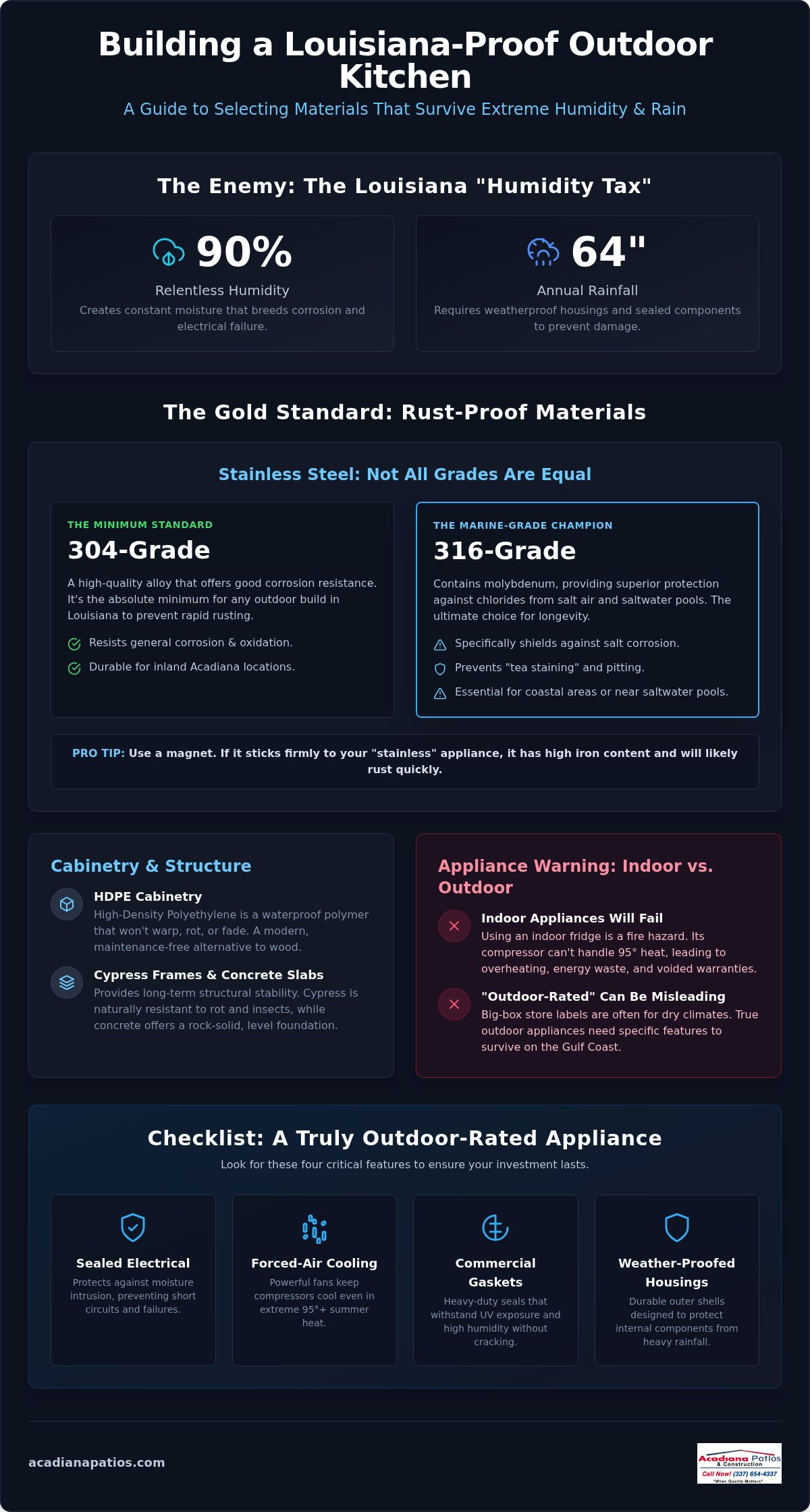
In Acadiana, we don’t just deal with seasonal rain; we live in a soup of high-dew-point air that never truly dries out. This constant moisture creates what we call the “Louisiana Humidity Tax.” It’s an invisible cost paid by homeowners who choose the wrong components for their backyards. While a grill might look shiny on a showroom floor, the best materials for outdoor kitchens in Louisiana are those that can handle 90% humidity without the internal electronics short-circuiting or the frame turning to dust. Standard “outdoor-ready” labels found in big-box stores are often designed for drier climates like Arizona or California. In South Louisiana, that same equipment often fails within two seasons because moisture becomes trapped inside the appliance housings, leading to irreversible corrosion.
Corrosion, Oxidation, and the Acadiana Air
The chemical reaction between our intense heat and constant moisture is relentless. When low-grade steel meets Acadiana air, oxidation begins almost immediately. Even in Lafayette, which is inland, we still experience salt-tinged air during storm seasons that accelerates this process. You’ll first notice “tea staining,” which looks like small brown specks on the surface of your cabinets or grill. If you don’t use Marine-Grade Stainless Steel or high-quality 304 stainless, those specks will eventually become structural holes. Many retail units use 430-grade stainless, which contains more iron and less nickel. This makes it significantly more susceptible to rust in our local climate compared to the heavier, more durable alloys we recommend for custom builds.
The Hidden Cost of Indoor-Only Appliances
It’s tempting to slide an old indoor refrigerator into a new outdoor island, but this is a significant safety risk. Indoor compressors aren’t designed to vent heat effectively when the ambient temperature is 95 degrees with high humidity. They work overtime, leading to massive energy efficiency losses and, in some cases, electrical fires. Beyond the safety concerns, using an indoor unit outdoors immediately voids the manufacturer’s warranty. A true outdoor-rated unit is one of the best materials for outdoor kitchens in Louisiana because it features specific protections:
- Sealed electrical connections to prevent moisture intrusion and short circuits.
- Powerful forced-air cooling systems that maintain temperatures in extreme heat.
- Commercial-grade gaskets designed to withstand UV exposure and heavy humidity.
- Weather-proofed housings that protect the compressor from our 64 inches of annual rainfall.
Choosing the right materials from the start ensures your kitchen remains a place for family gatherings rather than a source of constant maintenance and replacement costs. We view the outdoor kitchen as a complete structural system where every fastener and finish must be chosen to withstand the unique environmental pressures of the Gulf Coast.
The Gold Standard: Selecting Materials That Won’t Rust
Choosing the best materials for outdoor kitchens in Louisiana requires an understanding of the hierarchy of durability. Not all metals are created equal, and in our climate, galvanized steel or low-grade aluminum will fail almost immediately. While 304-grade stainless steel is the industry minimum for Lafayette builds, homeowners seeking the ultimate peace of mind often look toward marine-grade options. The goal is to select materials that offer a chemical resistance to our high dew points and salt-heavy air. Beyond bare metal, powder-coated finishes have become a popular choice because they provide an extra baked-on layer of protection that seals the underlying structure from moisture.
304 Vs. 316 Grade Stainless Steel
The primary difference between these two grades is the addition of molybdenum in 316 stainless steel. This specific element creates a shield against chloride corrosion, which is essential if you live near the coast or have a saltwater pool. While 304 is highly durable, 316 is the true gold standard for resisting the “tea staining” mentioned previously. If you’re unsure which metal grade fits your specific backyard micro-climate, consulting with a local custom builder can help you avoid costly material mistakes. You can even test your current equipment with a simple magnet. High-quality 300-series stainless steel is generally non-magnetic; if a magnet sticks firmly to your grill, it likely contains high iron content and will rust in Acadiana’s humidity.
Marine-Grade Finishes and Protective Coatings
Modern hardware now utilizes PVD (Physical Vapor Deposition) coatings, which bond at a molecular level to provide a finish that is harder than the steel itself. This technology is particularly useful for handles and hinges that face constant friction. While many people prefer a “brushed” look, it’s important to realize that those tiny grooves can actually trap moisture and microscopic debris. A polished finish is technically more resistant to corrosion because it lacks these crevices. For those who want to move away from metal entirely, High-Density Polyethylene (HDPE) cabinetry has emerged as one of the best materials for outdoor kitchens in Louisiana. This polymer is completely waterproof, UV-stable, and won’t warp or rot like wood, making it a maintenance-free alternative for wet zones.
We also see a rise in the use of outdoor-rated porcelain and natural stone for appliance surrounds. These materials handle the expansion and contraction caused by our extreme temperature swings without cracking. For high-end surface inspiration, ID-SOL offers a specialized selection of premium tiles that demonstrate how dense, non-porous finishes can withstand environmental challenges while maintaining an elegant aesthetic. By integrating these surfaces into your design, you create a structural system that protects the more sensitive internal components of your appliances from the elements.
Essential Appliances Built for South Louisiana Weather
Choosing the best materials for outdoor kitchens in Louisiana isn’t just about the masonry or the frame; it’s about the precision-engineered appliances that serve as the heart of the space. In our region, a grill is more than a cooking tool; it’s a structural component that must withstand persistent moisture. We prioritize grills with cast stainless burners over standard tube burners. While tube burners are common in retail models, their thin walls are prone to rusting through from the inside out. Cast burners provide a heavy, solid mass that resists corrosion and maintains even heat distribution despite the constant Acadiana humidity.
High-Performance Grills with Sealed Electronics
Reliability in a wet climate starts with the ignition system. We recommend piezo ignition systems, which use a mechanical strike to create a spark, because they outperform battery-powered electronic igniters that often fail when moisture enters the housing. Look for “seamless” welds where the grill head meets the frame. These smooth joins prevent water from seeping into the firebox and damaging the internal components. A heavy-duty, double-lined hood is equally important, acting as a structural shield that protects the cooking surface from our frequent downpours. Precision in these small details is what separates a long-lasting build from a temporary one.
Outdoor-Rated Refrigeration and Ice Makers
When selecting refrigeration, the “UL Outdoor Rated” certification is the only standard that ensures the unit can operate safely in high-ambient heat. These units feature sealed compressors and stainless steel backs to prevent moisture intrusion. Forced-air cooling is a necessity here; it uses fans to circulate cold air, ensuring your beverages stay at 34 degrees even when Lafayette temperatures hit the mid-90s. For ice makers, managing condensation is the biggest challenge. A dedicated drainage system is critical to prevent standing water, which can lead to mechanical failure in our 24/7 high-dew-point environment. Avoiding “pitting” in your wet bar area also requires solid brass or 304 steel faucets that won’t corrode when exposed to the elements.
Weather-Tight Storage and Cabinetry
To keep your dry storage truly dry, look for a “rain gutter” design on the cabinet flanges. This channel diverts water around the door opening so that rain follows the exterior frame rather than leaking into your pantry. Every hinge should be soft-close and specifically treated for rust resistance to ensure smooth operation for years. Understanding these technical requirements is a key part of determining The Real Cost to Build an Outdoor Kitchen in Louisiana, as investing in the right equipment upfront prevents the expense of replacing failed appliances every few years. We believe in building it right the first time, using components that respect the local weather rather than fighting it.
Maximizing Appliance Lifespan with Smart Design
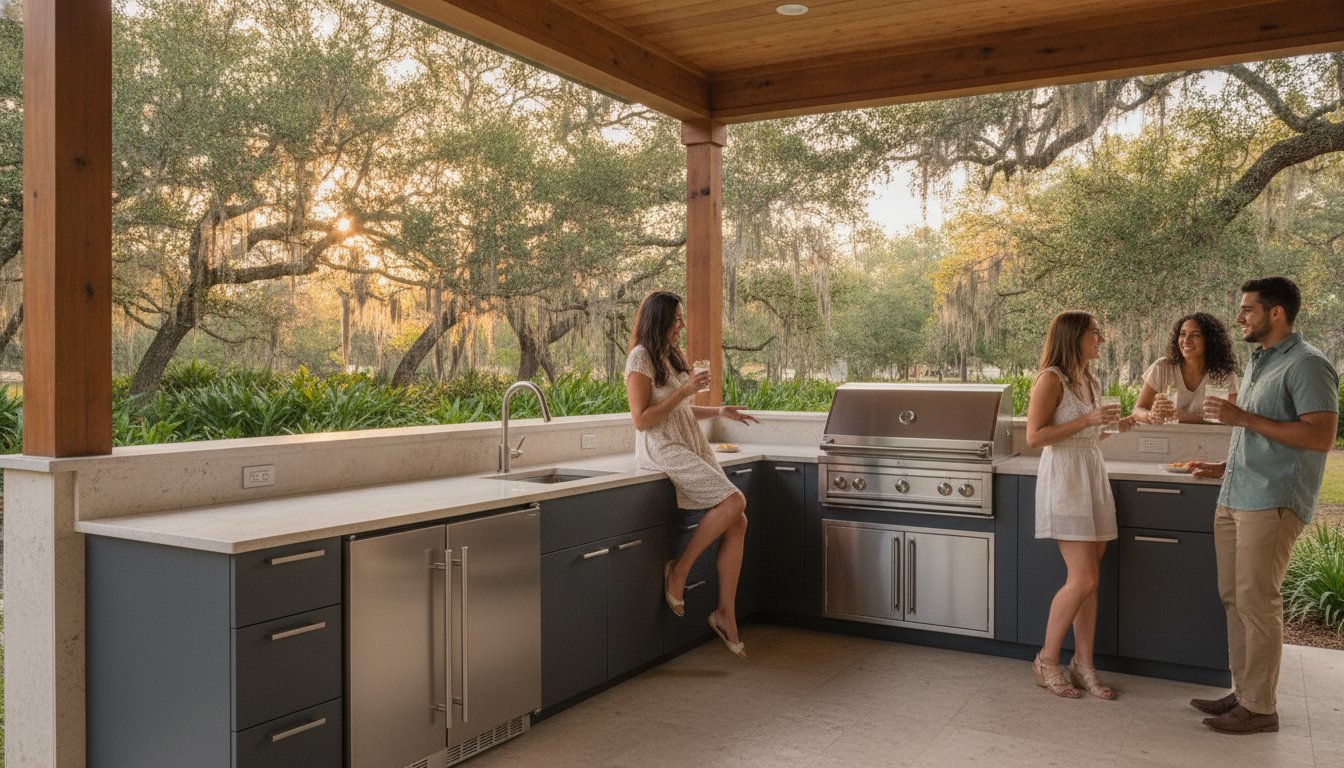
Even the best materials for outdoor kitchens in Louisiana will fail prematurely if they are left exposed to the brutal afternoon sun and stagnant air. Smart design is the difference between a kitchen that lasts five years and one that lasts thirty. We approach every build as a complete structural system where the layout is just as important as the steel grade. Strategic placement is your first line of defense. By keeping your high-performance appliances out of the direct path of the intense South Louisiana sun, you prevent the metal from reaching extreme temperatures that can degrade rubber seals and sensitive electronic circuit boards.
The Role of Insulated Patio Covers
Structural protection is the most effective way to reduce the long-term maintenance load for any homeowner. Installing an Insulated Patio Cover creates a controlled environment that can reduce ambient temperatures by 10 to 15 degrees. This temperature drop is vital for appliance efficiency; it allows your refrigerator’s compressor to cycle less frequently and prevents heat from being trapped inside cabinet voids. These covers also provide a physical barrier against vertical rain and the heavy morning dew that settles on surfaces, which is a primary driver of the corrosion we discussed in previous sections. Protecting your electronics from this direct moisture is non-negotiable for longevity.
Proper Ventilation and Vent Hoods
Airflow is a critical factor that many DIY builds overlook. “Dead air” spaces, where moisture can sit undisturbed for days, act as incubators for rust and mold. We design our custom kitchens to encourage cross-breezes that naturally wick away humidity. However, when a kitchen is situated under a pavilion or patio cover, high-CFM vent hoods are absolutely mandatory. These hoods do more than just remove smoke; they prevent grease and moisture from accumulating on the ceiling of your structure. Without proper extraction, that humid residue will eventually drip back down, damaging your finishes and creating a slip hazard on your concrete slab. A powerful hood pulls that oil-laden air out of the space, preserving your investment.
Professional installation ensures the entire system is properly integrated with your home’s existing infrastructure. This includes ensuring proper drainage so water never pools around the base of your cabinetry or structural posts. Most importantly, it involves expert electrical grounding. In the high-moisture environments typical of Acadiana, proper NEMA-rated enclosures and grounding are essential to prevent electrical failures and ensure the safety of your family. If you’re ready to design a space that stands up to the elements, contact our team of master builders today to start your custom project.
Designing Your Custom Acadiana Outdoor Kitchen
While pre-fabricated islands might look like a quick solution, they often harbor a hidden weakness. Many mass-produced units utilize thin, galvanized steel internal frames that are highly susceptible to the “Louisiana Humidity Tax” we discussed earlier. In our climate, these frames can corrode unseen behind a stone or stucco veneer, eventually compromising the entire structure. To maintain the integrity of your island’s finish, you can discover Premier Plastering for expert stucco application and repair. Choosing a custom build allows you to select the best materials for outdoor kitchens in Louisiana from the ground up, ensuring every structural rib and fastener is built to handle the environment.
A truly durable kitchen starts with a rock-solid foundation. We recommend integrating your appliances directly into custom-built structures anchored to a reinforced concrete base. Using stamped concrete provides a moisture-proof, slip-resistant surface that can handle the weight of heavy grills and stone counters without shifting over time. For a classic aesthetic that respects our local heritage, pairing these appliances with a cypress wood frame is an excellent choice. Cypress is naturally rot-resistant and handles our high moisture levels better than almost any other timber, making it one of the best materials for outdoor kitchens in Louisiana when you want a natural look. For more details on creating the perfect base, see our Lafayette, LA Stamped Concrete Patio Installation Guide.
Professional Installation and Local Support
The complexity of South Louisiana weather means that professional installation is a necessity rather than an option. A local Lafayette contractor understands the specific drainage requirements and wind-load needs of Acadiana. There is also immense value in working with a one-stop-shop that handles both the kitchen build and the protective patio cover. This ensures that the electrical grounding, gas lines, and structural supports are all engineered to work as a single, cohesive system. To help you organize your project, we’ve developed a Backyard Renovation Lafayette LA: The Ultimate 2026 Planning Checklist.
Before you break ground, use this final checklist to ensure your space is “Louisiana-proof”:
- Material Grade: Confirm all metal is at least 304 stainless steel or higher.
- Foundation: Ensure your concrete slab has a slight pitch to prevent standing water.
- Protection: Verify the kitchen is positioned under an insulated cover to block UV rays and vertical rain.
- Ventilation: Check that the design allows for constant airflow to prevent “dead air” moisture pockets.
- Warranty: Ensure your appliances carry a full outdoor-rated warranty specifically for high-humidity zones.
Investing in quality now means you’ll spend your weekends grilling and relaxing, rather than scrubbing rust or scheduling expensive repairs. By treating your outdoor kitchen as a master-built structural system, you create a legacy space for your family to enjoy for decades. Our team is here to ensure every detail, from the concrete slab to the last hinge, meets the high standards your home deserves.
Build Your Forever Backyard with Confidence
Constructing an outdoor space in Acadiana requires more than just a good eye for design; it requires a deep understanding of our unique climate. You now know that selecting the best materials for outdoor kitchens in Louisiana means prioritizing marine-grade metals and integrating structural protection like insulated patio covers. By focusing on sealed electronics and rot-resistant cypress frames, you ensure your investment survives our relentless humidity and heavy rainfall.
At Acadiana Patios & Construction, we’ve spent over 30 years refining our specialized approach to humidity-resistant building. Our family-operated team brings A+ rated local craftsmanship to every project, treating your backyard as a complete structural system rather than a collection of parts. We’re here to help you navigate the technical details so you can get back to what matters: enjoying your home with the people you love.
Get a Custom Outdoor Kitchen Quote from Acadiana Patios today and start building a space that stands the test of time.
Frequently Asked Questions
Is 304 stainless steel rust-proof in Louisiana humidity?
304 stainless steel is highly resistant to corrosion but is not entirely rust-proof in South Louisiana’s persistent humidity. While it is one of the best materials for outdoor kitchens in Louisiana, it can still develop “tea staining” if moisture and salt sit on the surface for too long. Regular maintenance, such as wiping the surfaces with a specialized stainless steel cleaner, is necessary to keep the protective chromium oxide layer intact.
Can I put a regular refrigerator in my outdoor kitchen?
You should never use a standard indoor refrigerator in an outdoor setting. Indoor units aren’t designed to vent heat in ambient temperatures that exceed 90 degrees, which causes the compressor to work constantly until it fails. Additionally, indoor models lack the sealed electrical components required to prevent moisture-related short circuits. Using an indoor appliance outdoors poses a significant fire risk and immediately voids your manufacturer’s warranty.
How often should I clean my outdoor appliances to prevent rust?
We recommend a light cleaning every two to four weeks to prevent the buildup of environmental pollutants. In Acadiana, where we see 64 inches of annual rainfall, it’s wise to wipe down your surfaces after major storm events. Use a soft cloth and a dedicated stainless steel protector to create a barrier against the air. This routine maintenance takes only minutes but can extend the life of your equipment by several years.
Do I need a vent hood for an outdoor kitchen under a patio cover?
A high-CFM vent hood is mandatory if your cooking station is located under a ceiling or patio cover. Without proper ventilation, grease and smoke will accumulate on the underside of your structure, leading to permanent staining and potential fire hazards. A professional extraction system also pulls humid air away from your grill’s control panel. This protects the internal electronics from the corrosive effects of trapped moisture and heat.
What is the best material for outdoor kitchen cabinets in a humid climate?
High-Density Polyethylene (HDPE) and 304-grade stainless steel are the best materials for outdoor kitchens in Louisiana cabinetry. HDPE is a marine-grade polymer that is completely waterproof and will never rot, warp, or delaminate in our humidity. If you prefer a metal look, powder-coated stainless steel adds an extra layer of baked-on protection. These materials ensure your storage remains structural and attractive despite constant exposure to the elements.
How do I protect my outdoor kitchen electronics from moisture?
Protection starts with ensuring all electrical outlets and connections are housed in NEMA-rated, weather-proof enclosures. You should also choose appliances with sealed control panels and piezo ignition systems that don’t rely on sensitive battery packs. Strategic placement under an insulated patio cover further shields electronics from direct rain and morning dew. We also suggest using high-quality vinyl covers for your grill and prep stations when they are not in use.
What is the difference between outdoor-rated and marine-grade appliances?
Outdoor-rated appliances are built with sealed components and weather-resistant finishes designed for general exterior use. Marine-grade appliances take this a step further by utilizing 316 stainless steel, which contains molybdenum for increased resistance to chloride corrosion. While outdoor-rated units are suitable for most Lafayette backyards, marine-grade is the superior choice for homes near the Gulf or those with saltwater swimming pools where the air is naturally more corrosive.
Is a gas or electric grill better for high-humidity environments?
Gas grills are typically the better choice for high-humidity environments like South Louisiana. Electric grills rely on heating elements and complex internal wiring that can be more susceptible to moisture-related failures over time. A quality gas grill with cast stainless burners and a mechanical ignition system offers the most reliable performance in our climate. It minimizes the number of sensitive electrical components that could be compromised by 90% humidity levels.