

Does a Sunroom Add Value in Lafayette? How Much to Expect
A sunroom can add value, but it may not return its full cost when you sell. For homeowners asking whether a sunroom adds value to a home in Lafayette, the broad U.S. estimate is a resale return of about 49-55% of the project cost; a heated, cooled four-season room typically returns around 50 to 60%. The room’s design and how well it fits the house also matter.
A bright, comfortable room can make a home more appealing, but enjoyment and resale value are not the same. The sunroom’s construction, insulation, heating, and eligibility as living space all affect how buyers and appraisers may view it.
This guide explains what those features can mean for value in Lafayette, how sunroom returns compare with other home improvements, and why a sunroom may be a lifestyle choice as much as a resale investment. You’ll also see how Acadiana Patios & Construction’s experience building sunrooms in Lafayette and Acadiana since 1985 fits into planning a space that complements your home.
Key Takeaways
- Use typical resale-return estimates as a planning guide, not a promise of recovering the full project cost.
- Compare three-season and four-season designs by how often you’ll use the room and how year-round comfort affects its appeal.
- Insulation, permanent heating, foundation, permits, and access from inside the home can affect whether a sunroom qualifies as listed living space.
- Weigh the addition against other improvements, since some renovations may recoup a larger share of their cost at resale.
How Much Value Does a Sunroom Add?
For homeowners asking whether a sunroom adds value to a home in Lafayette, national estimates are only a starting point, not a local appraisal. Ongoing costs such as maintenance, energy, and insurance depend on upkeep, how often you heat or cool the room, and how the addition affects your home’s insured value.
Resale Value and Investment Return
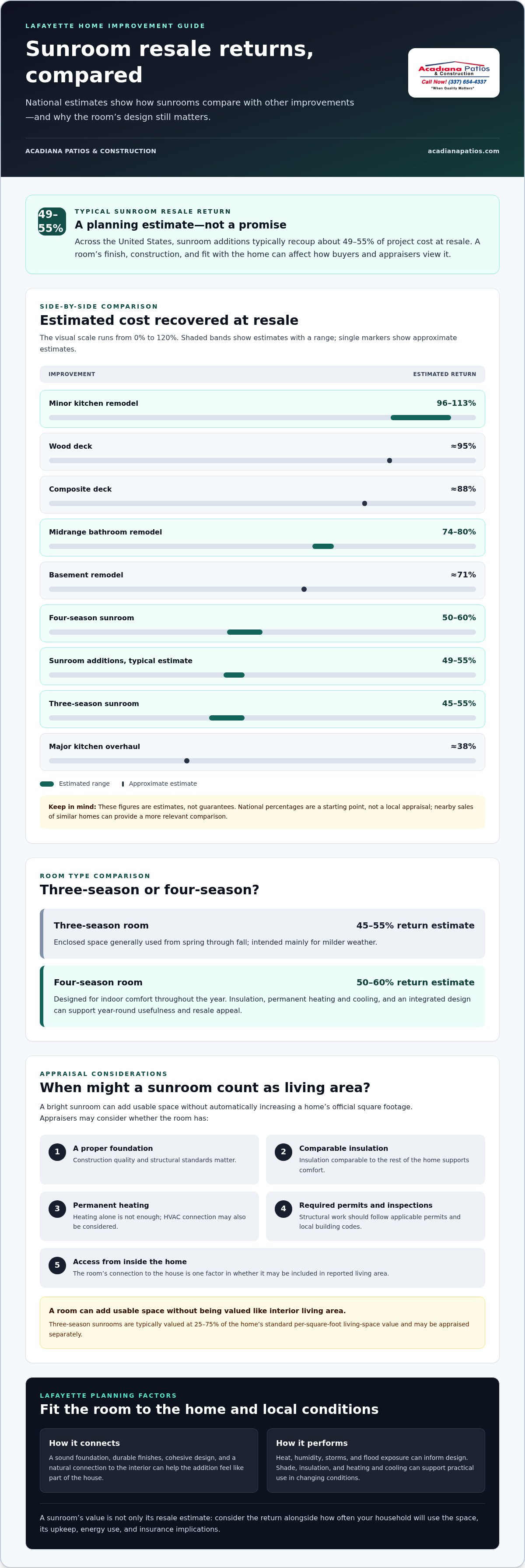
Return on investment compares the resale value gained with the amount spent on an addition. Across the United States, sunroom additions typically recoup approximately 49-55% of their project cost at resale, so homeowners should plan for value as well as enjoyment.
A national estimate does not mean every sunroom adds the same value. Buyers and appraisers consider how the room fits the home, its finish, and whether it functions as usable living space. A bright addition that connects naturally to the house may attract more interest than a room that feels separate or limited.
Construction Quality and Resale
Construction quality describes how well the addition is built and integrated with the existing home. A sound foundation, durable finishes, and cohesive design can help the room feel like part of the house rather than an afterthought.
That distinction matters at resale. A poorly integrated room may be less appealing, even if it adds space. Consider how it connects to the interior, matches the home’s style, and serves a clear purpose. These details shape buyers’ perception of the addition and its contribution to the property.
Nearby sales can make your estimate more relevant. Compare similar homes with and without sunrooms, accounting for differences in condition, layout, and reported living area. This gives you a more useful local comparison than applying a national percentage directly to a Lafayette home.
Other renovations may return a larger share of their cost. Estimates put minor kitchen remodels at 96-113%, wood decks at approximately 95%, composite decks at approximately 88%, and midrange bathroom remodels at 74-80%. Basement remodels are estimated at approximately 71%, while major kitchen overhauls return approximately 38%. Compare the likely resale benefit with how your household will use each improvement.
Four-season versus three-season sunroom value
A three-season room is intended mainly for milder weather, while a four-season room is designed for indoor comfort throughout the year. In Lafayette, insulation, heating, and the room’s connection to the house can affect both its usefulness and resale appeal.
Insulation, permanent heating and cooling, and a design that feels integrated with the home can strengthen resale appeal. Four-season rooms may be more useful to buyers because they can be used year-round, while three-season rooms are generally used from spring through fall.
For structural changes, obtain the required permit and follow local building codes. Requirements depend on the work and the property, so a sunroom should not be assumed to follow the same rules as a screened porch.
Requirements for All-Season Use
An all-season sunroom is a finished space designed for comfortable use throughout the year. Its foundation, insulation, heating, and connection to the home matter because they affect comfort and whether it may qualify as living area.
It should have a proper foundation, insulation comparable to the rest of the house, and permanent heating. A dedicated, adequately sized HVAC unit may serve the room instead of the home’s central system. Necessary permits and inspections support its status as a heated, finished space.
Local Conditions and Sunroom Design
Local conditions include heat, humidity, storms, and flood exposure, all of which can inform design choices. In a hot climate, an uninsulated sunroom can feel like a greenhouse in summer, limiting comfort and how often you use it.
For a Lafayette project, consider how shade, insulation, and heating and cooling will support practical use in changing conditions. Storm exposure and flood risk also make site-specific planning important, as these factors can shape the design and its appeal to buyers.
A screened porch offers an open-air alternative for entertaining, while a three-season sunroom adds an enclosed space that is generally usable from spring through fall. Three-season rooms are estimated to return 45-55% of their cost; four-season rooms typically return 50 to 60%. These estimates provide a comparison, not a guarantee of what a particular home will gain.
To weigh an enclosed room against an open-air design, explore sunroom options in light of your household’s comfort and use needs.
How insulation and heating affect listed living space
Insulation and permanent heating affect comfort, appraisal treatment, and whether an addition may qualify as gross living area. A bright sunroom can expand daily living space without automatically increasing the home’s official square footage.
Appraisals and Gross Living Area
Gross living area is finished space an appraiser may include in a home’s reported living area. A sunroom generally needs permanent heating, insulation comparable to the rest of the home, a proper foundation, required permits, and access from inside to be considered for inclusion.
Heating alone is not enough. Appraisers may also consider the room’s connection to the home’s HVAC system, its foundation, and whether it meets structural standards. A three-season room may be appraised separately rather than included in the home’s official square footage.
Appraisal treatment can vary with construction quality and finish. Three-season sunrooms are typically valued at 25-75% of the home’s standard per-square-foot living-space value. That range makes the distinction important: a room can add usable space and resale value without being counted equally with interior rooms.
Expanded Living Space
A sunroom expands living space by creating an additional area for activities such as reading, dining, or entertaining. Insulation can help regulate temperature and conserve energy, while efficient windows can bring in natural light during daytime use.
For year-round comfort, plan the room as part of the home’s living environment, not simply as an enclosed porch. Permanent heating, suitable insulation, a proper foundation, and interior access all contribute to that function. A separate HVAC unit may serve the room instead of the home’s central system.
Keep usable space distinct from official gross living area in property records. Permits and inspection reports help document a heated, finished addition. If a sunroom does not meet the conditions for inclusion, it can still be practical living space, but should not be assumed to count as standard interior area.
Sunroom returns compared with other home improvements
Resale return is only one way to judge a sunroom’s value. In Lafayette, compare its likely resale appeal with how your household will use the space, the local climate, and other ways to improve your home.
Industry estimates suggest four-season sunrooms can generate a 4-8% sale price premium over comparable homes without one. Treat that as a comparison between homes, not a guaranteed return on a project. Nearby sales, the addition’s finish, and whether buyers see it as a useful extension of the home all influence its appeal.
Other projects may perform differently. Remodeling Magazine’s Cost vs. Value Report ranks home additions, including sunrooms, among projects that can improve resale value and attract buyers. It also highlights an important distinction: natural light, entertaining space, or a home office can be valuable without necessarily outperforming other improvements financially.
Compare options by the need each one addresses. A kitchen update changes a frequently used interior; an outdoor improvement supports time outside; a heated sunroom creates an enclosed space for use in more seasons. Consider whether an addition fills a real gap in your home. Its value to your lifestyle matters even when resale is not the only measure.
For a practical comparison, review nearby sales of similar homes with and without sunrooms. Consider whether local buyers value year-round indoor comfort, flexible use, or a stronger connection to outdoor living. A sunroom that complements the home may be more appealing than one that feels disconnected. If resale is your main goal, compare its likely appeal with other improvements before deciding where to invest.
Planning an addition around both use and resale starts with a clear design conversation. Explore sunroom options for a space shaped around your home and lifestyle.
Acadiana Patios & Construction: Motorized Shades & Screens
Acadiana Patios & Construction helps homeowners plan outdoor living projects around how they intend to use the space. If you are considering a sunroom, look beyond resale estimates: daylight, privacy, and comfort also affect how well it works day to day.
Motorized Shades & Screens can help manage light and privacy in an outdoor living area. Other options include screened enclosures, Cypress Patio Covers, and Concrete Slabs & Concrete Coloring. The right choice depends on the space you want and how you plan to use it.
To plan a project that fits your home’s design and practical needs, contact Acadiana Patios & Construction or visit acadianapatios.com.
Plan an Outdoor Space That Fits Your Home
Deciding whether a sunroom adds value to a home in Lafayette is part of a broader question: what kind of space will serve your household over time? Consider how you want to use it, how it should connect to your home, and whether an indoor or outdoor setting better fits your routines.
Planning may also point to other options. Motorized Shades & Screens can help shape light and privacy, while Cypress Patio Covers create a covered outdoor area. Carports & Garages address a different household need. Choose the option that supports your priorities and complements the property, rather than focusing on resale value alone.
Bring your project goals and questions to Acadiana Patios & Construction to discuss a fitting next step. Contact Acadiana Patios & Construction and start planning a space that feels right for your home.
Frequently Asked Questions
Does adding a sunroom increase square footage?
A sunroom can add usable space, but it does not automatically increase the official square footage listed for a home. A three-season room, for example, may be described separately from gross living area. Clear listing details help buyers distinguish enclosed bonus space from standard interior living area.
How Much ROI Can You Expect?
A four-season sunroom with heating and cooling typically returns around 50 to 60 percent of its construction cost at resale. To judge whether that tradeoff fits your plans, consider how frequently your household will use the room, along with its likely appeal to buyers. A space you enjoy daily can have value beyond its resale contribution.
Is Adding a Sunroom Before Selling Worth It?
A sunroom may make sense if it meets a clear buyer need and complements the home, but it is not automatically the best pre-sale project. Compare recent sales of similar nearby properties, then weigh the room’s likely appeal against focused updates to existing spaces. A room designed mainly around your preferences may not match what local buyers value.
What side of the house should a sunroom be on?
Choose the orientation based on when you expect to use the room and how much sunlight you want. South-facing rooms receive more sun exposure across seasons; north-facing rooms get less direct sun, which can help keep them cooler in warmer regions. East-facing rooms suit morning use, while west-facing rooms receive afternoon sun.
How much does a sunroom increase home value in Lafayette, Louisiana?
There is no fixed value increase for every Lafayette home. To assess whether a sunroom adds value to a home in Lafayette, compare nearby sales and consider the room’s condition, integration with the house, and use as living space. A well-matched addition may appeal to buyers, while local sale prices and the home’s position in the market also shape its contribution.
What is the typical resale ROI for a sunroom addition?
U.S. estimates put a sunroom addition’s typical resale return at approximately 49-55% of project cost. Use that as a national benchmark when comparing options, not as a precise forecast for a Lafayette property. The local result depends on comparable home sales, construction quality, and how well the addition suits the home and its likely buyers.